1. Slavic and Old Church Slavonic
1.1. The Slavic languages
1.1.1. Distribution of the Slavic languages
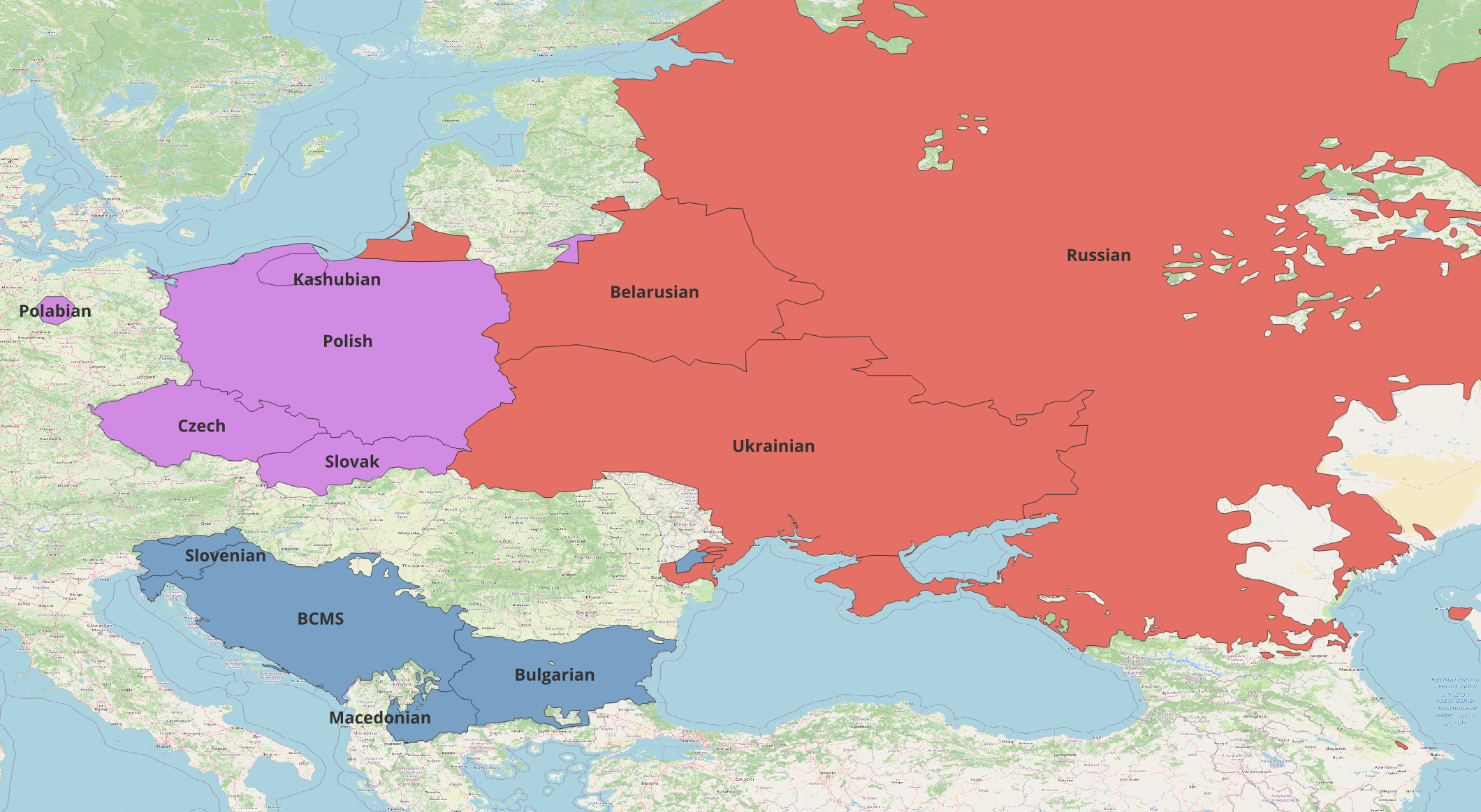
Slavic languages are distributed across Central and Eastern Europe, in the Balkans and in Central and North Asia (Siberia) (see Figure 2). They are spoken by around 315 million people.
1.1.2. Traditional subgrouping
The Slavic languages (Glottocode: slav1255)
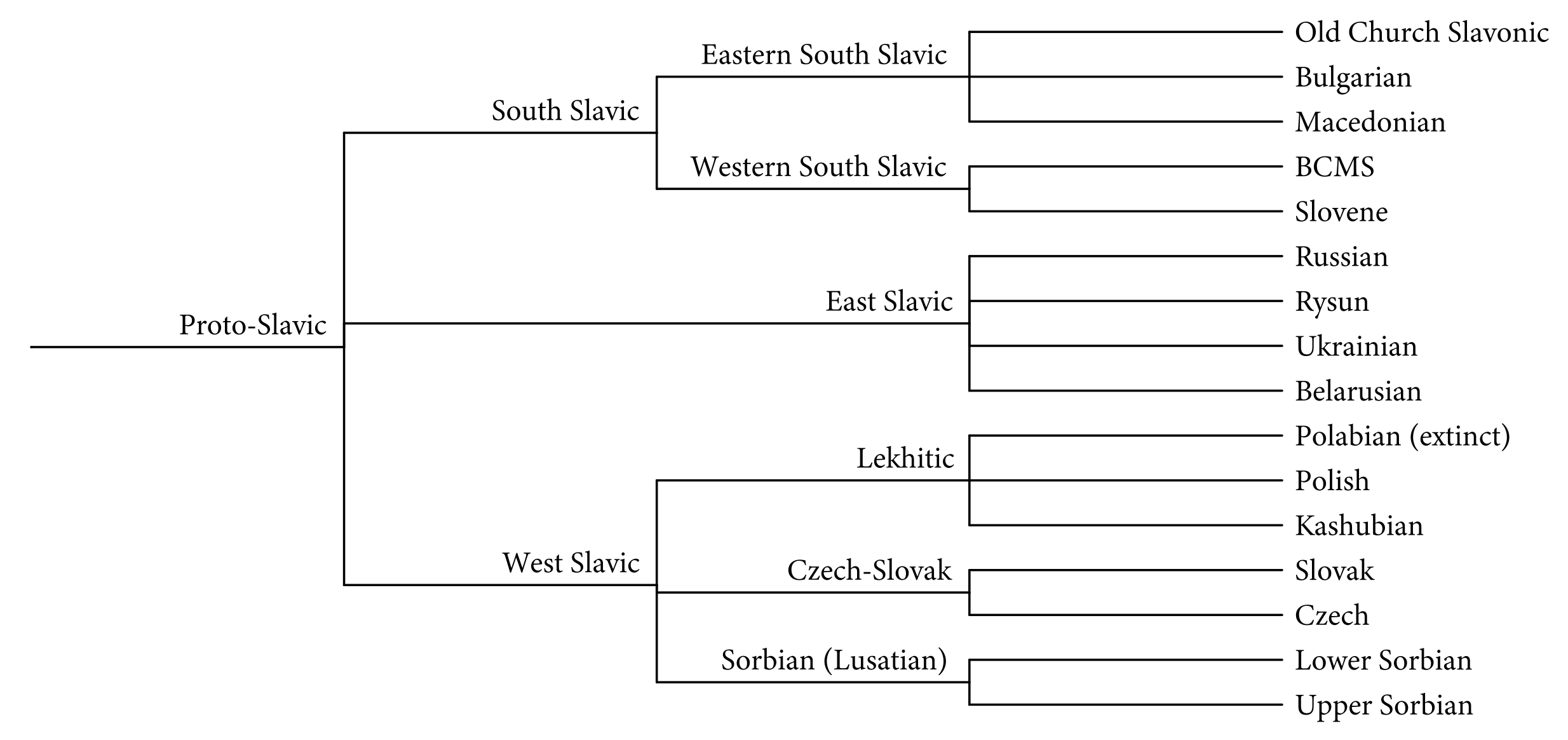
are traditionally divided into three main subgroups.
1. South Slavic (sout3147)
2. East Slavic
3. West Slavic
- Lekhitic
- Sorbian
- Czecho-Slovak (
czec1260)
A typical family tree can be seen in Figure 3.
In practice, the Slavic languages constitute a dialect continuum, with overlapping isoglosses that make it difficult to make a clear phylogenetic model. While the traditional tripartite subgrouping may not reflect the true phylogenetic relationships among the languages, it still constitutes a useful framework for making generalised statements about them. For historical overviews see Blažek (2020); Saenko (2020).
It is difficult to find systematic treatments of the subgrouping of Slavic based on shared innovations (cf. Mareš 1980; Schenker 1993: 60–61; Poljakov 2018: 1588–1589). Criteria that are mentioned in connection with the subgrouping of Slavic are mostly phonological, e.g.:
- the outcome of PS *ti̯ di̯ (CS *tʲ dʲ) (see 3.4.7)
- the outcome of the Liquid Metathesis (see 3.4.5)
There are morphological and lexical differences as well, but they are more difficult to get hold of.
I am not aware of any computational studies dealing specifically with the subgrouping of Slavic; those concerned with the entire Indo-European language family are based on lexicon and of dubious value for Slavic (Gray & Atkinson 2003: 437, implying that Polish is more closely related to East Slavic than to Czech and Slovak; Bouckaert et al. 2012: Supplementary Materials p. 24, again with Polish in a weird place; Heggarty et al. 2023: Supplementary Materials p. 57, with OCS and Slovene forming an outlier; for criticism of the two former publications see Pereltsvaig & Lewis 2015: 83–85).
1.1.3. The position of the Old Novgorod dialect
Spoken in the Novgorod–Pskov area in north-western Russia, it seems to be an early outlier in the Slavic family (“North Slavic”) (Nasirpour 2025; Andersen 2026). Some of the features characteristic of the Old Novgorod dialect distinguishing it from the other Slavic dialects are the following:
Old Novgorod dialect does not have the regressive part of second palatalisation (Zaliznjak 2004: 45–47); see 3.4.4.
- ONovg. o-stem pron. adj. nom.sg.m kěle from PS *ˌkai̯lə ‘whole’ – all other Slavic dialects have reflexes of *cě̑lŭ
There is probably no progressive palatalisation of *x (and possibly *g).
- pron. dat.pl (kŭ) vĭxemo (i.e. vĭxěmŭ) < PS *u̯iˈxai̯mə ‘all’; all other Slavic languages point to CS *vĭśěmŭ (cf., however, Galinskaja 2014)
According to a minority view, the Old Novgorod dialect also shows a special development of PS *ə̄̆ (from pre-PS *ā̆ in final syllables ending in *-s) (Zaliznjak, Nikolaev and Dybo apud Zaliznjak 2004: 148–149; Olander 2012): PS *ə ə̄ > “classical” CS *ŭ y || ONovg. e ě
- OCS, OESl. nom.sg xlěbŭ m ‘bread’ vs. ONovg. xlěbe
1.2. Proto-Slavic and Common Slavic
“Proto-Slavic” reconstructions are traditionally written as a kind of lightly modified OCS; for instance, the word for ‘water’ is reconstructed as *vodà (cf. OCS voda, Ru. vodá, Po. woda etc.), and the word for ‘whole’ is reconstructed as *cě̑lŭ (cf. OCS cělŭ, Ru. célyj, Po. cały etc.).
However, from (1) loanwords to and from Slavic, (2) internal phonological correspondences in the Slavic languages and (3) information from the Old Novgorod dialect we can see that actual Proto-Slavic – in the sense of the language state from which all the known Slavic languages can be derived – looked quite different: the word for ‘water’ probably rather sounded *u̯aˈdā in actual Proto-Slavic, and the word for ‘whole’ was *ˌkai̯lə (see Olander 2015: 64; Holzer 1997)
1. Loanword relations: Traditionally, “Proto-Slavic” forms are reconstructed with the sequences *or ol.
- *golvà f ‘head’ > OCS glava, Ru. golová
- *stornà f ‘side; land’ > OCS strana, Ru. storoná
- *gȏrdŭ m ‘fortification; town’ > OCS gradŭ, Ru. górod
But loanwords from Slavic that contain such sequences seem to always have *ar al, suggesting that Proto-Slavic *a had not yet become *o when the Liquid Metathesis took place. Since the Liquid Metathesis had different results in the Slavic languages, it must have taken place after the dissolution of Proto-Slavic.
Accordingly, forms like *golvà, *stornà and *gȏrdŭ probably never existed; the actual Proto-Slavic forms are *gālˈu̯ā, *starˈnā and *ˌgardə
2. Internal Slavic correspondences: It is easier to understand the Liquid Metathesis in South Slavic (and Czecho-Slovak) as a development *ar > *rā > *ra than *or > *ra, since if *a > *o happened before the Liquid Metathesis, *or would probably have become *rō or *ro, but this did not happen (Lindstedt 1991: 114–115).
3. The Old Novgorod dialect (see also 1.1.3): In contrast to all other Slavic languages, the Old Novgorod dialect clearly does not have the regressive part of the Second Palatalisation (see 3.4.4).
- ONovg. o-stem pron. adj. nom.sg.m kěle from PS *ˌkai̯lə ‘whole’ (vs. reflexes of *cě̑lŭ in all other Slavic dialects), showing that Proto-Slavic must have had *k‑ in this word
Thus, these reconstructions are anachronistic, but in reality give a good picture of the Slavic dialect continuum as it was spoken until the loss of the reduced vowels around 1200 CE (3.4.12). Moreover, it is practical to represent Slavic reconstructions in the traditional notation, partly because it is the way it has always been done, and partly because the words are immediately more easily recognisable. Accordingly, I (and others) refer to the traditional notation as “Common Slavic”, and “Proto-Slavic” denotes reconstructions of the actual common point of departure for the Slavic languages.
Proto-Slavic refers to the stage after the First Palatalisation (e.g. *ke > *če; 3.4.1) and before changes like the vowel palatalisations (e.g. *i̯a > *je; 3.4.2), the monophthongisation of oral diphthongs (e.g. *ai̯> *ě; 3.4.3) and the Second Palatalisation (e.g. *kai̯ > *cě; 3.4.4) (cf., somewhat differently, Klotz 2023; Olander 2015: 46–67).
1.3. Slavic and the other Indo-European branches
1.3.1. Slavic and Baltic
The relationship between Baltic and Slavic is debated: have they developed in parallel since PIE times, or did an actual Balto-Slavic proto-language exist at some point in prehistory?
At this point it is probably safe to say that Baltic the communis opinio assumes a Balto-Slavic subgroup of Indo-European (for literature on the problem see Olander 2019; Wandl & Olander 2026). Notably, all phylolinguistic studies of the Indo-European language family that I am aware of group Baltic and Slavic together, with no exceptions.
Among the significant common innovations found in Baltic and Slavic are the following:
- Hirt’s Law: the accent is retracted from an accented syllable to an immediately preceding syllable which ends in a postvocalic laryngeal (3.2.5)
- loss of laryngeals: in pre-Proto-Balto-Slavic when syllable-final laryngeals are lost, a preceding vowel is lengthened and and becomes acute, also across an intervening resonant. (3.2.4)
- Winter’s Law: a vowel is lengthened and becomes acute before an original voiced unaspirated stop (*VD > *V̰̄D); a vowel is glottalised before a sonorant followed by an original voiced unaspirated stop (*VRD > *V̰RD) (3.2.8)
- accentual mobility: certain word-forms accented on the ending in PIE receive initial accent (more precisely: become unaccented) in Proto-Balto-Slavic (3.2.7)
- development of IE *r̥ l̥ to both *ir il and *ur ul (the precise conditioning is unclear in both Baltic and Slavic) (2.2)
- formation of a new preterite suffix *-ē-/-ā-
- use of the ablative singular for the genitive singular in the o-stems
1.3.2. The position of Balto-Slavic in the Indo-European family
It is disputed what the closest relative of the Balto-Slavic subgroup is. It has been argued that the ruki change (3.2.3) may be a shared innovation of Balto-Slavic and Indo-Iranian (e.g. Ringe & Taylor 2007: 6–7; see also Ringe, Warnow & Taylor 2002; Nakhleh, Ringe & Warnow 2005; but cf. Hock 2021: 594–597, arguing that Ruki is a transitional phenomenon). On the other hand, Balto-Slavic and Germanic share the striking use of *m for *bʰ in oblique dual and plural case endings, which also has the appearance of a shared innovation.
Some authors give a negative appraisal of the possibility of grouping Balto-Slavic with any other Indo-European branch (e.g. Pronk 2022: 279–285).
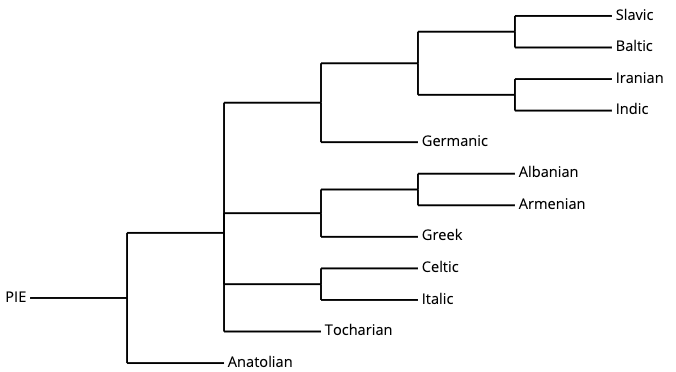
A preliminary majority consensus tree resulting from the research project Connecting the Dots: Reconfiguring the Indo-European family tree can be seen in Figure 4.
For an attempt at matching population genetic relationships with linguistic branches see Gretzinger (2026: 31). For the genetic background of Slavic-speaking populations see Gretzinger et al. (2025); Gretzinger (2026: 38–39).
1.4. Old Church Slavonic
1.4.1. The OCS corpus
OCS is the first ample direct attestation of the Slavic branch of Indo-European. The OCS manuscripts date to the 10th (the Kiev Leaves) and 11th centuries, which is late compared to many other branches of Indo-European. The Freising Fragments (Sln. Brižinski spomeniki) in Old Slovene are from around 1000 AD.
The language of the OCS corpus is based on a South Slavic dialect closely related to later Bulgarian and Macedonian dialects. OCS is sometimes referred to as Old Bulgarian; cf. e.g. the title of Leskien’s Grammatik der altbulgarischen (altkirchenslavischen) Sprache (Leskien 1919a).
The OCS texts all serve religious purposes. The following shows the OCS manuscript, the script they are written in, and the number of folios they contain (Andersen & Olander forthcoming; cf. Vaillant 1964: 14–16; Schaeken & Birnbaum 1999: 87–91).
1. Gospel
- Codex Zographensis, Glagolitic, 270 fols.
- Codex Marianus, Glagolitic, 173 fols.
- Codex Zographensis Palimpsest, Glagolitic, 16 fols.
2. Aprakos Gospel (gospel readings for feast days)
- Codex Assmanianus, Glagolitic, 158 fols.
- Savvina Kniga, Cyrillic, 130 fols.
- Vatican Palimpsest, Cyrillic, 93 fols.
- Ohrid Leaves, Glagolitic, 2 fols.
- Fragmentum Sinaiticum, Glagolitic, 1 fol.
- Palimpsest of Bojana, Glagolitic, 2 fols.
- Undol´skij’s Leaves, Cyrillic, 2 fols.
3. Apostolos (Acts of the Apostles, Catholic epistles and Pauline epistles from the New Testament)
- Kiev Leaf, Glagolitic, 1 fol.
- Apostolus of Enina, Cyrillic, 39 fols.
4. Psalter
- Psalterium Sinaiticum, Glagolitic, 209 fols.
- Dimitrij’s Psalter, Glagolitic, 145 fols.
5. Liturgical texts (for church services)
- Kiev Leaves (Kiev Folios, Kiev Missal), Glagolitic, 7 fols.
- Euchologium Sinaiticum, Glagolitic, 134 fols.
- Sinai Missal, Glagolitic, 3 fols.
- Missale Sinaiticum, Glagolitic, 80 fols.
- St. Petersburg Octoich, Glagolitic, 8 fols.
- Menaeum Sinaiticum, Glagolitic, 2 fols.
6. Edificational literature
- Codex Suprasliensis, Cyrillic, 285 fols.
- Glagolita Clozianus, Glagolitic, 14 fols.
- Rila Leaves, Glagolitic, 8 fols.
- Hilandar Leaves, Cyrillic, 2 fols.
- Zographos Leaves, Cyrillic, 2 fols.
- Grigorovič’s Leaf, Glagolitic, 1 fol.
- Hilferding’s Leaf, Cyrillic., 1 fol.
1.4.2. The creation of the Glagolitic and Cyrillic alphabets
The following account is a shortened version of the one found in Andersen & Olander (forthcoming).
Around 862 two brothers from Thessaloniki, Methodius (c. 815–885) and Cyril (b. Konstantinos, c. 826–869), were sent on a mission from Constantinople to Moravia (present-day eastern Czechia and Hungary), where they spent three years. The brothers spoke not only Greek, but also a South Slavic dialect; Thessaloniki had a large Slavic-speaking population.
According to tradition, Cyril created the Glagolitic alphabet, and the brothers translated the most important liturgical texts into their variety of South Slavic. The original language of the translations is referred to as “Urkirchenslavisch”, German for “Proto-Church Slavonic” (see Schaeken & Birnbaum 1999: 13–15).
While the mission to Moravia ultimately failed, the followers of Cyril and Methodius relocated to Bulgaria and established a highly influential school there.
While the Cyrillic script is named after Cyril, most scholars agree that it was created later, on the basis of Glagolitic. Most of the Cyrillic letters are derived from Byzantine Greek majuscules (uncial, large book script letters), with Byzantine Greek pronunciation.
Both scripts are based on a phonological analysis of OCS.
The majority of the OCS manuscripts are written in the Glagolitic script; an important exception is the Codex Suprasliensis, written in Cyrillic (see 1.4.1).
Note that in this course we do not use the Glagolitic script; OCS is given in Cyrillic and/or Roman.
Glagolitic does not distinguish between ě and ja, nor e and je.
| Cyr. | Glag. | translit. | name | Cyr. | Glag. | translit. | name |
|---|---|---|---|---|---|---|---|
| а | Ⰰ | a | azŭ | ф | Ⱇ | f | frĭtŭ |
| б | Ⰱ | b | buky | х | Ⱈ | x | xěrŭ |
| в | Ⰲ | v | vědě | ц | Ⱌ | c | ci |
| г | Ⰳ | g | glagoli | ч | Ⱍ | č | črĭvĭ |
| д | Ⰴ | d | dobro | ш | Ⱎ | š | ša |
| є е э | Ⰵ | e, je | jestŭ | щ | Ⱋ | št | šta |
| ж | Ⰶ | ž | živěte | ъ | Ⱏ | ŭ (ъ) | jerŭ |
| ѕ | Ⰷ | dz | dzělo | ы ъи | ⰟⰉ ⰟⰋ | y | jery |
| з | Ⰸ | z | zemlja | ь | Ⱐ | ĭ (ь) | jerĭ |
| і | Ⰹ Ⰺ | i | i | ѣ | Ⱑ | ě | jatĭ |
| и | Ⰻ | i | iže | ю | Ⱓ | ju | – |
| (ћ) | Ⰼ | ǵ | ǵervĭ | я | – | ja | – |
| к | Ⰽ | k | kako | ѥ | – | je | – |
| л | Ⰾ | l | ljudije | ѧ | ⱔ | ę | – |
| м | Ⰿ | m | myslite | ѩ | ⱗ | ję | – |
| н | Ⱀ | n | našĭ | ѫ | ⱘ | ǫ | – |
| о | Ⱁ | o | onŭ | ѭ | ⱙ | jǫ | – |
| п | Ⱂ | p | pokojĭ | ѯ | – | ks | ksi |
| р | Ⱃ | r | rĭci | ѱ | – | ps | psi |
| с | Ⱄ | s | slovo | ѳ | ⱚ | θ | θita |
| т | Ⱅ | t | tvrĭdo | ѵ | ⱛ | ü | ižica |
| ѹ у | Ⱆ | u | ukŭ | ѡ | Ⱉ | o | otŭ |
A transliteration tool for Early Cyrillic to Latin is available at sproghistorie.dk/ocstrans.
1.4.3. Local variants of the Cyrillic alphabet
Variations of the Cyrillic script are still used across eastern Europe and Asia. A reform by Peter the Great (1672–1725) in 1708 changed the shape of the Cyrillic letters to a form resembling the Roman script (see this blog post with illustrations).
In Bulgaria, Macedonia and Serbia local variants of the letter shapes of the Cyrillic alphabet are used, as illustrated in Table 2.
| regular | italic | |
|---|---|---|
| Russian | вода | вода |
| Bulgarian | вода | вода |
| Serbian / Macedonian | вода | вода |
1.5. Handbooks
The Slavic languages in general and OCS in particular have a long and rich tradition of handbooks. The list below is not exhaustive; see Vaillant (1964), 16–18 for references to older handbooks.
1.5.1. Synchronic dictionaries of OCS
- Cejtlin, Ralja Mixajlovna, Robert Večerka & Emilie Bláhová.
1994. Старославянский словарь (по рукописям
Х–ХI веков). Москва. [full
text]
- dictionary of OCS (in Russian)
- Kurz, Josef & Zoe Hauptová. 1966–1997. Slovník jazyka
staroslověnského / Lexicon linguae
Palaeoslovenicae. Vol. 1–4. Praha: Academia. Online
version.
- a.k.a. SJS; dictionary of OCS (in Latin, with translations into Czech, Russian, German; the online version adds translations into English)
- Sadnik, Linda & Rudolf Aitzetmüller. 1955. Handwörterbuch zu
den altkirchenslavischen Texten (Slavistische Drukken
En Herdrukken). ’s-Gravenhage: Mouton.
- widely used dictionary of OCS (in German)
1.5.2. Etymological dictionaries of Slavic languages
There are numerous etymological dictionaries of the individual Slavic languages. Here are some of the important ones.
- Derksen, Rick. 2008. Etymological dictionary of the
Slavic inherited lexicon (Leiden Indo-European
Etymological Dictionary Series 4). Leiden & Boston: Brill.
- Slavic etymology from a Leiden School perspective; handy, but with very little discussion
- Havlová, Eva, Adolf Erhart & Ilona Janyšková. 1989–2018. Etymologický slovník jazyka staroslověnského. Vol. 1–19. Praha (1–14) & Brno (15–19): Academia (1–14) & Tribun EU (15–19).
- Klotz, Emanuel. 2023. Urslawisches Wörterbuch.
2., aktualisierte und erweiterte Auflage. Wien: Facultas.
- dictionary of Proto-Slavic in the strict sense (1.2), with reflexes in the Slavic languages (in German)
- Sławski, Franciszek. 1974–2001. Słownik prasłowiański. Vol.
1–8 (A–Gyža). Wrocław etc.
- unfinished dictionary of Common Slavic (in Polish)
- Snoj, Marko. 2016. Slovenski etimološki slovar. Tretja
izdaja. Ljubljana: Založba ZRC. Online
version.
- up-to-date dictionary of Slovene (in Slovene)
- Trubačёv, Oleg Nikolaevič. 1974–. Этимологический словарь
славянских языков: Праславянский лексический фонд. Vol. 1–. Москва:
Наука.
- a.k.a. ЭССЯ (ÈSSJa); very comprehensive, but still unfinished, etymological dictionary of Slavic (in Russian); PIE reconstructions are not up to date
- Vasmer, Max. 1953–1958. Russisches etymologisches
Wörterbuch. Vol. 1–3. Heidelberg.
- outdated, but still widely regarded the standard etymological dictionary of a Slavic language
- Vasmer, Max. 2006. Этимологический словарь русского языка.
4-е издание (online version). 4 vols. Москва: Прогресс. https://lexicography.online/etymology/vasmer/.
Online
version.
- Russian translation of Vasmer 1953–1958, with additions and comments by Trubačëv
1.5.3. Synchronic grammars of OCS
- Andersen, Henning & Thomas Olander. 2020. Old Church
Slavonic. Göttingen: Georg-August-Universität Göttingen. https://spw.uni-goettingen.de/projects/aig/lng-chu.html.
- for those who like watching videos
- Auty, R. 1968. Handbook of Old Church
Slavonic. Reprinted with corrections. Vol. 2. Texts and
glossary. London: The Athlone Press, University of London.
- companion to Nandriş 1968
- Birnbaum, Henrik & Jos Schaeken. 1997. Das
altkirchenslavische Wort (Slavistische
Beiträge 348). München: Sagner. [full
text]
- useful and comprehensive introduction to OCS; cf. Schaeken & Birnbaum (1999)
- Comrie, Bernard & Greville G. Corbett. 1993. The
Slavonic languages. London & New York: Routledge.
- overview of the Slavic languages plus Common Slavic
- Diels, Paul. 1963. Altkirchenslavische
Grammatik. 2. Ausg. Heidelberg: Winter.
- thorough and reliable grammar of OCS with texts and vocabulary (in German)
- Leskien, August. 1919b. Grammatik der altbulgarischen
(altkirchenslavischen) Sprache. 2. und 3. Auflage.
Heidelberg: Winter.
- OCS grammar; old but still very useful (in German)
- Leskien, August. 1922. Handbuch der altbulgarischen
(altkirchenslavischen) Sprache: Grammatik,
Texte, Glossar. Sechste Auflage.
Heidelberg: Winter. [full
text]
- OCS grammar with texts and dictionary; old but still very useful (in German)
- Lunt, Horace Gray. 2001. Old Church Slavonic
grammar. 7th ed. Berlin & New York: Mouton de Gruyter. https://doi.org/10.1515/9783110876888.
- in the 7th edition the chapter on “Toward a generative phonology of OCS” has been replaced by a chapter on “A sketch history: from late Indo-European to late Common Slavic”
- Nandriş, Grigore. 1959. Handbook of Old Church
Slavonic. Reprinted with corrections 1965. Vol. 1. Old
Church Slavonic grammar. London: The Athlone Press, University of
London.
- companion to Auty 1965
- Polivanova, Anna. 2023. Old Church Slavic:
Grammar and dictionaries (Biblioteca Di Studi
Slavistici 51). (Ed.) Artemij Keidan. Florence: Firenze
University Press. https://doi.org/10.36253/979-12-215-0104-9.
[full
text]
- I haven’t checked this one out
- Schaeken, Jos & Henrik Birnbaum. 1999. Die
altkirchenslavische Schriftkultur (Slavistische
Beiträge 382). München: Sagner. [full
text]
- useful and comprehensive introduction to OCS; cf. Birnbaum & Schaeken (1997)
- Vaillant, André. 1963–1964. Manuel du vieux slave. Seconde
édition revue et augmentée. Vol. 1. Grammaire; 2. Textes et glossaire.
Paris: Institut d’Études Slaves.
- thorough and reliable grammar of OCS with texts and dictionary (in French)
- Zaliznjak, Andrej Anatol’evič. 2014. Древнерусское ударение:
Общие сведения и словарь. Москва: Языки славянской
культуры.
- very useful accentological dictionary of Old Russian (Old East Slavic) (in Russian)
1.5.4. Historical grammars of Slavic languages
- Aitzetmüller, Rudolf. 1991. Altbulgarische
Grammatik als Einführung in die slavische
Sprachwissenschaft (Monumenta Linguae
Slavicae Dialecti Veteris. Fontes Et
Dissertationes 30). Freiburg i. Br.: Weiher.
- includes useful historical information (in German); largely based on Vaillant’s Grammaire comparée
- Bräuer, Herbert. 1961–1969. Slavische
Sprachwissenschaft. Vol. 1. Einleitung, Lautlehre; 2.
Formenlehre (1. Teil); 3. Formenlehre (2. Teil). Berlin: de Gruyter.
doi: 10.1515/9783110845549;
10.1515/9783110840759;
10.1515/9783110831573
- very good comparative grammar of the Slavic languages (in German), but unfinished (unfortunately no pronominal and verbal morphology)
- Olander, Thomas. 2015. Proto-Slavic inflectional
morphology: A comparative handbook (Brill’s
Studies in Indo-European Languages and
Linguistics 14). Leiden & Boston: Brill. https://doi.org/10.1163/9789004270503.
- includes overview of various authors’ historical analyses of Slavic endings
- Stang, Christian Schweigaard. 1942. Das slavische und baltische
Verbum (Skrifter Utgitt Av Det Norske
Videnskaps-Akademi i Oslo. 2.
Hist.-Filos. Kl.). Oslo: I kommisjon hos J. Dybwad.
- thorough and useful treatment of the verbal system of Slavic and Baltic (in German)
- Vaillant, André. 1950–1977. Grammaire comparée des langues
slaves (Collection ‘Les Langues Du
Monde’. Série Grammaire, Philologie,
Littérature 6, 11, 12). Vol. 1. Phonétique; 2/1. Morphologie (Flexion
nominale); 2/2. Morphologie (Flexion pronominale); 3. Le verbe; 4. La
formation des noms; 5. La syntaxe. Lyon & Paris.
- the standard work on Slavic historical grammar; very comprehensive (in French)